
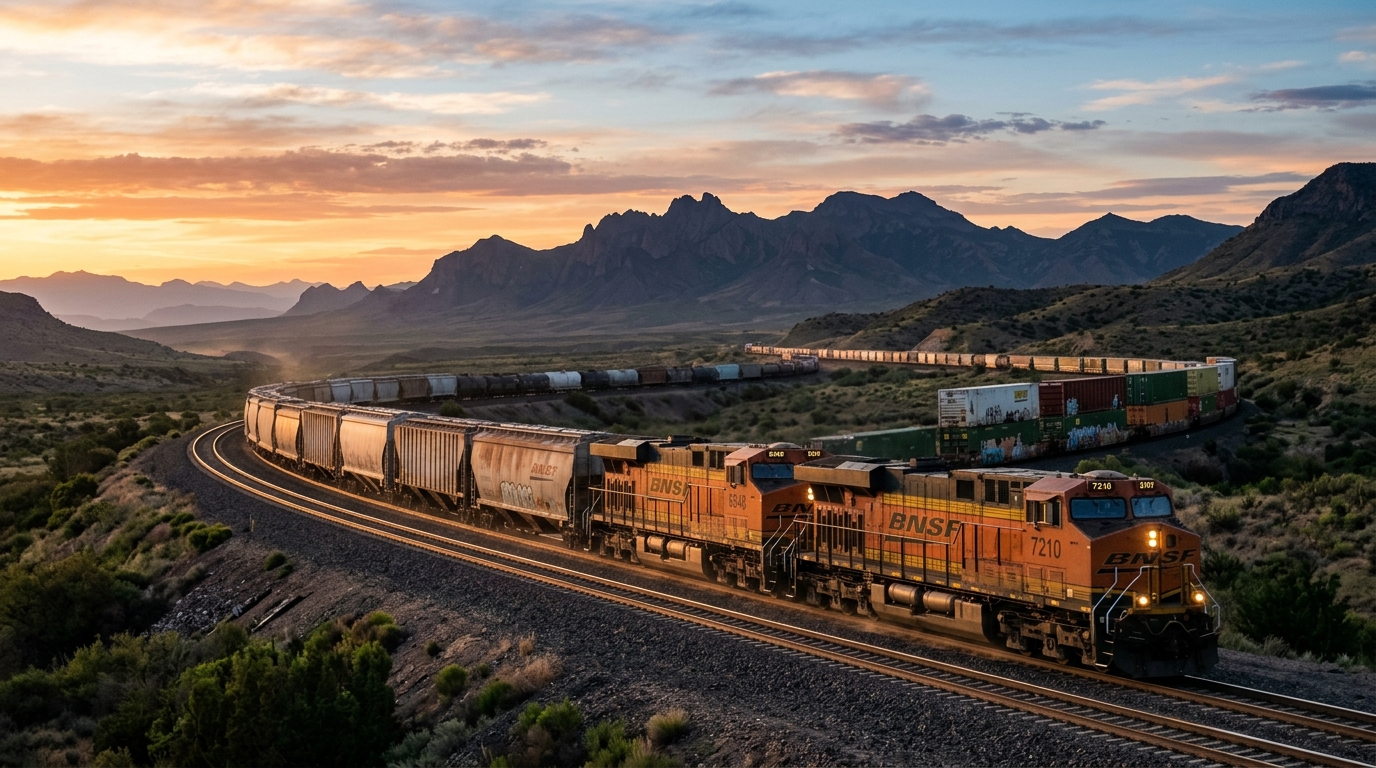
If rail keeps losing,
America pays.
More freight on overcrowded highways means more fuel consumed, more emissions, more wear on public infrastructure, and a freight system that becomes less efficient and less resilient.
NexGen is developing a turbine-electric locomotive power platform designed to lower operating costs, modernize existing fleets, and help railroads win freight back from the highway.
Rail is roughly four times more fuel-efficient than trucking.
The freight shift that could make a national difference.
Potential annual fuel savings from shifting 10% of large-truck freight to rail.
Potential annual reduction in greenhouse-gas emissions from the same shift.
*Modal-shift figures are Association of American Railroads estimates. They describe the potential national benefit of moving freight from truck to rail—not a result attributable to NexGen alone.
America's freight future is heading toward gridlock.
Rail should be one of America's greatest freight advantages. Instead, an aging system is losing relevance while highways absorb more long-haul freight.
Carrying the dominant and growing burden of long-haul freight
Underutilized potential despite superior mechanical fuel physics
Today, rail accounts for approximately 19% of freight ton-miles, compared with approximately 44% for trucking. The exact measures vary by dataset, but the direction is unmistakable: trucking absorbs the volume while rail's structural efficiency is sidelined.
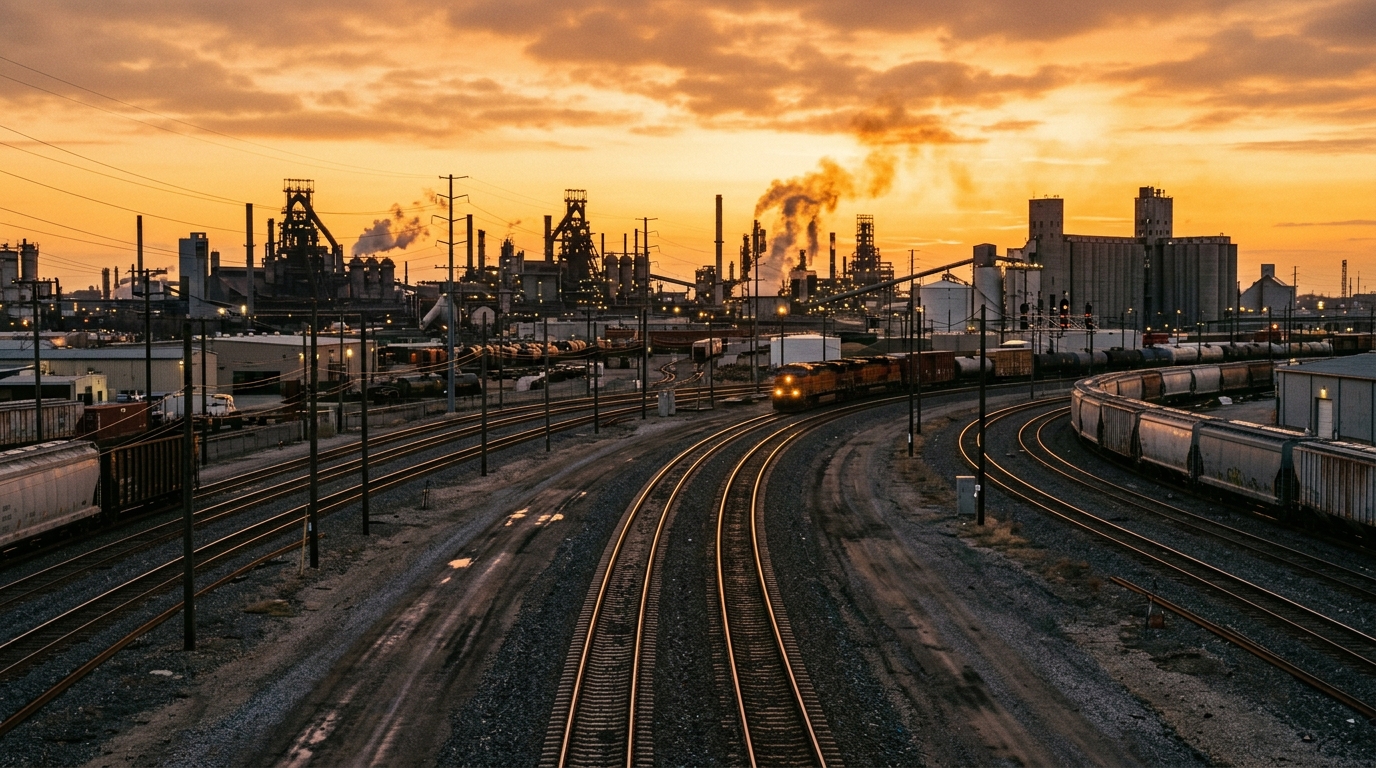
Fewer Competitive Options
Shippers confront a freight network with diminished bargaining leverage and limited route flexibility.
Highway Congestion
Motorists and regional corridors face intensifying truck volume, safety hazards, and commuting bottlenecks.
Infrastructure Degradation
Exponential road and bridge wear requires recurring public highway subsidy while private rail rights-of-way sit underused.
Excess Energy Consumption
The economy burns substantially more fuel to move identical freight mass across Interstate corridors.
Elevated Disruption Risk
Over-reliance on trucking magnifies systemic driver shortages, weather vulnerabilities, and diesel spot volatility.
Stranded Rail Utility
America extracts lower economic yield from thousands of route miles of privately capitalized rail network.
“The danger is not that every railroad disappears tomorrow. It is that rail becomes less competitive, less relevant, and less capable—one lost shipment at a time.”
Moving just 10% can change everything.
Rail already moves a ton of freight roughly four times farther on a gallon of fuel than trucking. Shifting just 10% of freight carried by the largest long-haul trucks to rail unlocks immediate, compounding physical and economic benefits.
Scale of National Impact
Association of American Railroads (AAR) modeled shift mechanics
Save over 1.5 billion gallons of fuel every year.
Drastic reduction in diesel combustion, insulating the domestic freight network from international oil shocks.
Reduce greenhouse gases by 17+ million tons annually.
Eliminating point-source corridor pollutants across high-density logistics corridors and urban centers.
Equivalent to removing ~3.2 million cars from roads.
Relieves highway gridlock, reduces asphalt rutting, and significantly improves commercial and personal safety.
This is bigger than a locomotive. It is a chance to reduce freight costs, relieve highway pressure, and make better use of infrastructure America has already built.
The missing link is a railroad power model that can compete for the freight. That is why we are working to Make Railroads Great Again.
*Modeled modal-shift estimates derived from Association of American Railroads published industry analysis. Actual outcomes depend on routes, equipment, operating duty cycle, and market conditions.
Rail has the advantage.
It is losing the ability to deliver it.
Railroads can move enormous loads over long distances with exceptional fuel efficiency. But much of the locomotive fleet still depends on power architecture designed generations ago.
Aging Locomotives
An aging North American fleet operating on extended lifespans, creating an acute reinvestment deficit across regional and mainline rosters.
Legacy Diesel Engines
Conventional reciprocating diesel prime movers rebuilt again and again, yielding diminishing returns on fuel burn and thermodynamic efficiency.
Fuel & Maintenance Exposure
High operational exposure to diesel price volatility paired with escalating mechanical maintenance overhead on thousands of moving engine parts.
Frequency & Reliability
Strained locomotive availability compromises scheduled turnarounds, velocity, and on-time intermodal delivery commitments.
Capital Constraints
Astronomical replacement costs ($4M–$6M+ per new locomotive) make wholesale fleet retirement financially untenable for most carriers.
Shippers Defaulting to Trucks
When rail service predictability wobbles, freight shippers default back to highway trucking despite paying higher transportation rates.
The result is a self-reinforcing downward loop that will not reverse itself on legacy technology:
Older Power
Drives Opex
Weakens Service
Hurt Velocity
Freight to Trucks
Shipper Loss
Starves Capex
No Modernization
“Rail does not need another defense of its past. It needs a credible way to win its future.”
The railroad is not obsolete.
The prime mover is.
America does not need to rebuild the entire railroad system from zero. The corridors already exist. So do the terminals, shops, locomotives, customer relationships, operating expertise, and industrial connections.
Keep the railroad.
That is where NexGen begins.
A new power architecture
for the railroad comeback.
NexGen is developing an integrated turbine-electric locomotive platform around the real duty cycle of freight rail—combining cryogenic LNG storage, high-efficiency turbine generation, permanent-magnet conversion, and battery buffering.
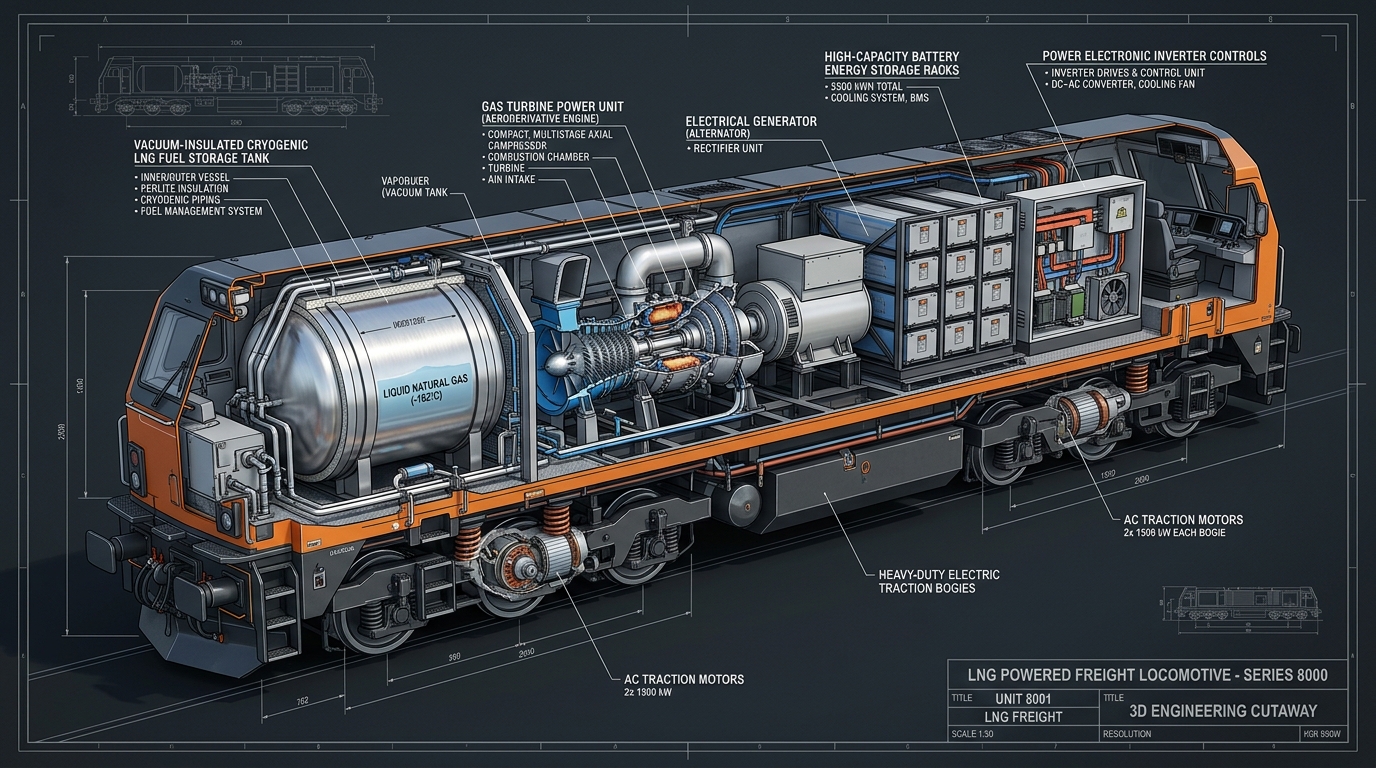
Cryogenic LNG storage and fuel delivery
A dense, transportable energy source designed for practical railroad operations and domestic fuel availability. Substantially higher volumetric energy density than battery-only tender designs, enabling sustained mainline range without loss of trailing tonnage.
Liquefied Natural Gas (LNG)
RNG / Bio-Methane
“Lighter power. Smarter energy. A locomotive built to compete again.”
*The NexGen platform is in development. Architecture, component specifications, configuration, integration, and performance remain subject to engineering, testing, and validation.
Use more of the energy.
Pay less for the fuel.
Clean technology does not transform an industry unless the economics work. NexGen attacks locomotive operating cost from thermodynamic cycle efficiency to domestic fuel price differential and simplified maintenance.
The Efficiency Case
Modernizing the thermodynamic cycle to capture significantly more work per British Thermal Unit (BTU).
High-efficiency closed/combined recuperated turbine cycle exceeding standard medium-speed diesel limits.
Projected efficiency improvement over conventional legacy diesel engines depending on baseline comparison and duty profile.
Absorbs acceleration peaks and grade transitions, keeping turbine generation locked inside its high-efficiency sweet spot rather than idling inefficiently.
The Fuel-Cost Case
Direct fuel cost reduction per locomotive based on defined mainline operational assumptions.
Substantial operating expense curtailment in mainline freight operations.
Modeled annual fuel expense reduction per modernized locomotive unit in defined Class I service.
Capital retrofit cost recouped within rapid commercial operating horizon at typical Class I utilization.
Estimate Fleet Cumulative Savings
Modeled scenario assumptions: $4.00/gal diesel, $1.00/gal LNG equivalent, 100,000 annual locomotive miles, and defined Class I mainline duty profile.
Actual economics vary by duty cycle, utilization, fuel contract, configuration, maintenance schedule, financing, and deployment conditions.
Lower cost without surrendering
the environmental case.
The strongest clean-freight solution is one railroads can afford to deploy. NexGen's planned architecture combines compelling operating margins with a cleaner, multi-stage locomotive decarbonization pathway.
Zero-NOx LNG Combustion
A combustion approach engineered to eliminate engine-out nitrogen-oxide (NOx) formation within the turbine architecture, tackling one of rail's toughest urban regulatory hurdles.
Lower Local Pollutants
Virtually zero sulfur emissions (SOx) and dramatically lower particulate soot emissions than conventional reciprocating diesel combustion.
Greater Energy Utilization
Higher cycle target efficiency, intelligent battery buffering, and regenerative downhill dynamic brake capture systematically minimize total fuel input required per gross ton-mile.
Lower-Carbon Fuel Pathway
LNG delivers immediately lower lifecycle carbon intensity than diesel, with seamless drop-in compatibility for Renewable Natural Gas (RNG) and biomethane.
A Carbon-Neutrality Pathway
Renewable fuels, high-efficiency turbine operation, future on-board carbon-capture development, and the far larger national benefit of shifting heavy freight from highway to rail converge toward carbon-neutral freight transport.
“Cleaner locomotive power today. A pathway toward carbon-neutral freight tomorrow.”
A practical transition pathway that respects rail capital realities rather than demanding unbuilt trillion-dollar overhead electrification.
*Zero-NOx, emissions, efficiency, renewable-fuel, carbon-capture, and carbon-neutrality statements describe design objectives or development pathways unless explicitly identified as independently validated results.
The comeback will be
measured on the track.
Transformational infrastructure earns confidence one milestone at a time. NexGen's program advances methodically from integrated architecture to instrumented comparison at the Transportation Technology Center (TTC) and commercial demonstration.
System Architecture
Define and integrate turbine, permanent-magnet generator, battery buffer, controls, cryogenic fuel system, and locomotive interface.
Engineering & Supplier Integration
Coordinate specialized tier-1 technology partners and translate component capability into a unified railroad power package.
Prototype Development
Fabricate the hardware test skids and control platforms required to measure, refine, and prove the architecture.
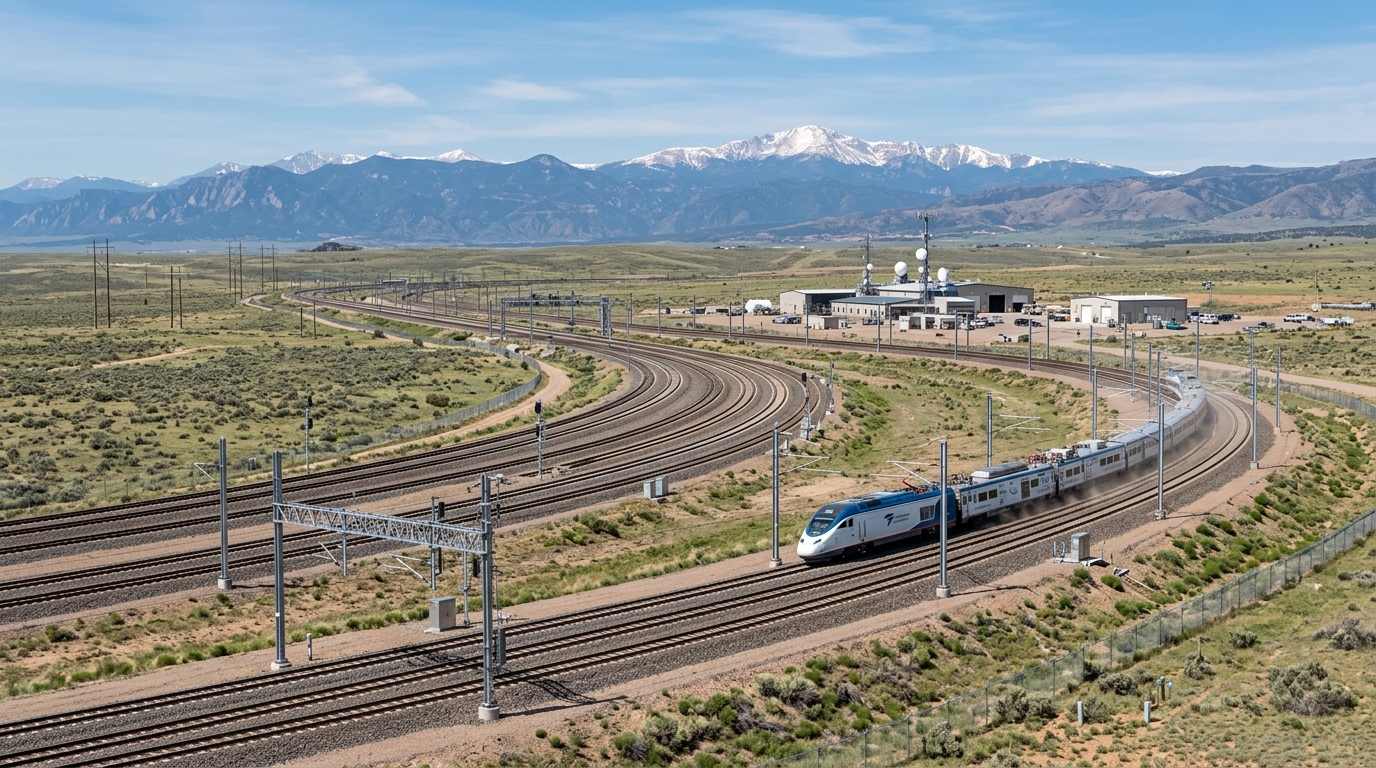
Controlled Testing (TTC)
Pursue planned track validation at the FRA-owned, ENSCO-operated Transportation Technology Center in Pueblo, Colorado.
Instrumented Comparison
Measure the NexGen LNG architecture directly against a diesel baseline across tractive effort, fuel burn, emissions, and thermal curves.
Railroad Demonstration
Validate operational turnaround, fueling rhythm, and operating crew ergonomics in an initial customer railroad deployment.
Commercial Pilot & Fleet Expansion
Convert instrumented operational data into standard multi-unit retrofits, maintenance agreements, and commercial fleet adoption.
Collaborating with Industry Leaders
NexGen is working with Hitachi Industrial Products and a broader ecosystem of specialized engineering, component, testing, and railroad organizations to advance the planned platform.
*Relationships, facilities, and planned activities do not imply completed testing, certification, endorsement, purchase commitments, or commercial deployment. Partner wording and logo use require written approval.
The right duty cycle
can start the comeback.
Different railroads create different paths to value. NexGen begins with operations where duty cycles can be strictly bounded, deployment is practical, and empirical metrics can be verified.
Short-Line & Regional Railroads
Defined point-to-point routes, concentrated local switching operations, direct access to executive leadership, and visible regional community benefits create the ideal launchpad for operational demonstration.
- ✓ Clearly understood duty cycles: Predictable horsepower demands and repeatable daily switching rhythms.
- ✓ Centralized fueling: Simplified, single-point LNG supply logistics without nationwide cryogenic tender networks.
- ✓ Accessible maintenance: Tight proximity to regional mechanical shops and local service crews.
- ✓ Local impact: Measurable regional air quality and fuel savings in non-attainment rail yards.
- ✓ Grant alignment: High eligibility for CRISI, DERA, and state clean-diesel modernization incentives.
Class I Mainline Railroads
High annual locomotive utilization (100,000+ miles/year) and massive standardized fleet populations create the ultimate commercial volume and nationwide emissions reduction opportunity.
- ✓ Larger annual fuel savings: Millions of gallons conserved per locomotive lash-up annually.
- ✓ Accelerated payback: Modeled 3.33–3.75 year capital amortization under high mainline utilization.
- ✓ Compatible population: Massive addressable rosters of EMD and GE road switcher locomotives.
- ✓ Network-scale impact: Transcontinental freight shifts that move millions of highway truckloads back to steel rail.
- ✓ Commercial expansion: Repeatable drop-in power modules across Tier-1 transcontinental networks.
“Short lines can accelerate validation. Class I fleets can accelerate economics and scale.”
Tell us about your fleet, route, duty cycle, fuel burn, shop capabilities, and modernization roadmap.
One architecture.
Thousands of potential locomotive applications.
NexGen is pursuing a modernization thesis built around widely deployed, proven locomotive platforms—not a speculative requirement to replace trillions of dollars of rail infrastructure at once.
Potentially addressable EMD 645 and 710 locomotive rosters in active service across North America.
Deep industry shop familiarity, standardized maintenance tooling, and established supply chains.
Seven Class I railroads and a handful of holding companies control the vast majority of mainline power.
Spanning power module retrofits, system integration, continuous service, fuel delivery, and telemetry.
The Platform Expansion Thesis
The opportunity begins with the prime mover. It expands into a broader ecosystem of locomotive equipment, cryogenic energy distribution, long-term service agreements, duty-cycle telematics, and trackside infrastructure.
*Addressable-fleet and market figures are planning estimates subject to validation. Detailed market sizing, account assumptions, pricing, bookings projections, and investment information should be presented through approved investor materials.
Prove it in rail.
Extend it wherever resilient power is needed.
Freight rail is one of the world's most demanding mobile-power environments: extreme continuous duty cycles, intense vibration, weather extremes, and instant throttle response. If a power architecture thrives here, it thrives anywhere.
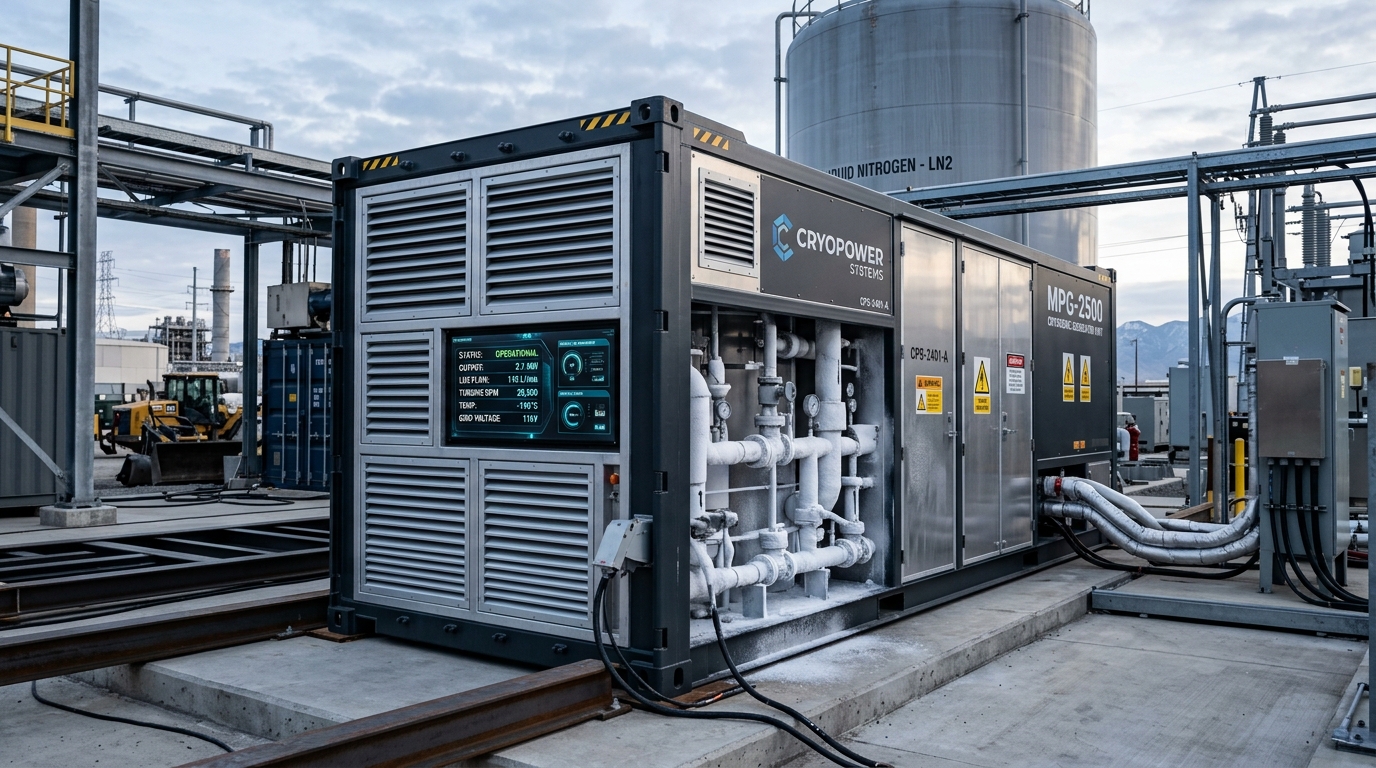
Mining, Port & Captive Rail
High-torque closed-loop haulage networks with dedicated private infrastructure.
Distributed Mobile Generation
Rapidly deployable skid and railcar power for emergency and seasonal utility surges.
Industrial Microgrids
On-site prime power shielding industrial facilities from grid interconnection delays.
Data-Center Resilience
Ultra-clean, high-density turbine prime power for AI compute and hyperscale campuses.
Tactical Microgrids
Isolated defense installations and remote energy infrastructure independent of local grids.
Digital Energy Management
Real-time edge diagnostics, fuel logistics telemetry, and performance uptime contracting.
“Rail is the mission. Rail is the proof. Rail can be the beginning.”
*Adjacent applications are strategic opportunities, not announced commercial products. Their timing and viability depend on engineering, market validation, partnerships, capital, and regulatory requirements.
Help power the
railroad comeback.
Modernizing freight rail requires alignment across operators, capital partners, technology providers, and public advocates. Select your role to access tailored briefings and direct collaboration channels.
Turn your operating profile into a modernization case.
Explore whether your fleet, routes, utilization, fueling pattern, maintenance capabilities, and economic priorities align with a NexGen demonstration or future deployment.
The rails are already here.
The comeback is ready to be powered.
Lower operating costs can help railroads compete.
Cleaner power can help freight move with less environmental impact.
Modernizing the locomotive can help America unlock more value from the infrastructure it already built.
The problem is urgent. The opportunity is enormous. The work starts now.